Paddy Bonner is one of the most respected names in the history of Irish football, particularly among supporters of Celtic and the Republic of Ireland. Born in Clochglas, County Donegal, on 24 May 1960, he developed into a distinguished goalkeeper whose professional career was defined by remarkable consistency. His journey from local football to Celtic Park and the international stage remains an inspiring story of talent, dedication and longevity.
Although officially known as Patrick Joseph Bonner, he has also been widely recognised as Pat or Packie Bonner, while Paddy Bonner is another name frequently used when people search for his story. His connection with Celtic began in 1978, and he remained with the Glasgow club for almost two decades. During that time, he became a club legend and an important figure in Irish football.
Paddy Bonner’s Early Life and Football Background
Paddy Bonner grew up in County Donegal, an area with a deep football culture and a particularly strong connection with Celtic. He began developing his goalkeeping skills with local side Keadue Rovers before attracting wider attention. His ability was evident at a young age, and by the time he was 16, he had attended trials with Leicester City and appeared for the club in the FA Youth Cup.
His progress eventually brought him to the attention of Celtic scout Sean Fallon, who was searching for promising talent in Ireland. Bonner travelled to Glasgow for a trial and impressed enough to earn a contract. On 14 May 1978, he signed for Celtic, becoming Jock Stein’s final signing for the club. That early opportunity laid the foundation for a career that would become deeply connected with Celtic’s history.
Paddy Bonner’s Celtic Career
Paddy Bonner made his Celtic first-team debut on 17 March 1979, when Celtic defeated Motherwell 2–1 at home. His early years involved competition for the goalkeeper’s position, but his performances gradually established him as a dependable presence between the posts. His athleticism, bravery and shot-stopping ability helped him develop into one of the club’s most trusted players.
His Celtic career eventually stretched across 19 years, making him one of the longest-serving goalkeepers in the club’s history. Celtic’s official profile records 641 appearances and 253 clean sheets, while FIFA records 642 appearances when discussing his career. Either figure illustrates the extraordinary scale of his contribution. His longevity was matched by domestic success, with Celtic winning several major honours during his time.
Paddy Bonner’s Major Achievements at Celtic
One of the defining features of Paddy Bonner’s Celtic career was his collection of domestic honours. Celtic’s official records credit him with four league titles, three Scottish Cups and one League Cup. He was particularly important during the championship-winning seasons of 1981, 1982, 1986 and 1988. His success also included a place in the Celtic side that secured the club’s famous Centenary Double.
Bonner’s reliability was equally important to his reputation. Celtic records show that he kept 253 clean sheets across his 641 appearances, including 180 in league matches. His ability to remain at the club for such a long period while maintaining a high level of performance made him more than simply a successful goalkeeper. He became a familiar and trusted figure for generations of Celtic supporters.
Paddy Bonner and the Republic of Ireland
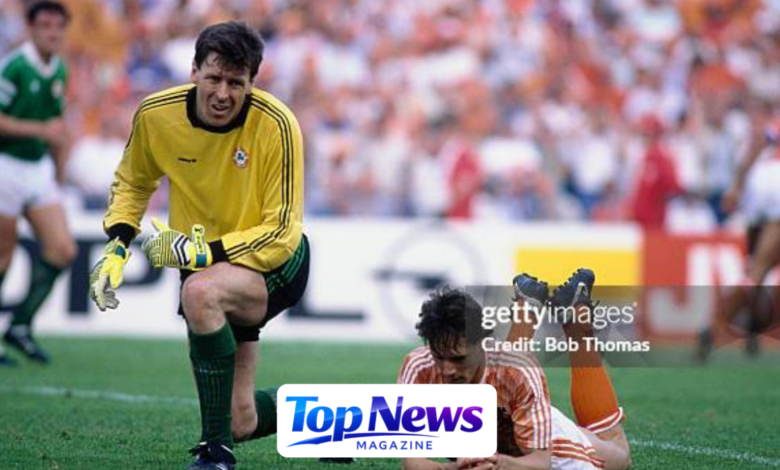
Paddy Bonner’s reputation extended far beyond Celtic Park because he became a major figure for the Republic of Ireland. He earned 80 international caps and represented his country during an important period in Irish football. His international career included major tournaments, but one particular moment at the 1990 FIFA World Cup transformed him into a national sporting hero.
At Italia 1990, Ireland faced Romania in the last 16, with the match eventually reaching a penalty shoot-out. Bonner saved Daniel Timofte’s penalty, helping Ireland progress to the quarter-finals. FIFA describes the moment as the save for which he became particularly famous, and its importance remains firmly established in Irish sporting history. It was one of the defining moments of his international career.
Paddy Bonner’s 1990 World Cup Heroics
The famous penalty save against Romania was not simply another good goalkeeping moment. It came during Ireland’s historic 1990 World Cup campaign and helped the team reach the quarter-finals. Bonner’s diving save stopped Timofte’s effort, after which David O’Leary converted Ireland’s decisive penalty. The result sent Ireland through and created one of the most memorable images in the nation’s football history.
FIFA has noted that Bonner had produced many other excellent saves throughout his career, yet none carried the same significance as the penalty against Romania. The moment became part of his identity because it arrived on one of the biggest stages in international football. It also demonstrated his ability to handle pressure when the consequences of a single action could be enormous.
Paddy Bonner’s Playing Style and Strengths
As a goalkeeper, Paddy Bonner became known for qualities that allowed him to remain effective over many seasons. His athleticism and shot-stopping ability were particularly respected, while his bravery gave him the confidence to deal with difficult situations inside the penalty area. Celtic sources also highlight his remarkable record of clean sheets, demonstrating how consistently he protected the goal.
His longevity also says something about his mentality. Goalkeepers face intense pressure because mistakes can immediately change the outcome of matches, yet Bonner remained Celtic’s leading goalkeeper across a remarkably long period. His ability to recover from difficult moments and maintain confidence helped him establish a career that was based not only on individual saves but also on sustained reliability.
Paddy Bonner’s Final Celtic Years
The final chapter of Paddy Bonner’s playing career with Celtic included a memorable Scottish Cup triumph. His last competitive appearance came in the 1995 Scottish Cup final against Airdrie, which Celtic won 1–0. Ending his Celtic playing career with silverware was a fitting conclusion to a journey that had already included league championships, Scottish Cups and a League Cup.
After his final playing appearance, Bonner continued his association with Celtic in a coaching capacity before eventually leaving the club in 1998. His departure marked the end of an extraordinary relationship with one team. Unlike many professional footballers who move between several clubs, his entire senior club career was centred on Celtic, making his loyalty an important part of his legacy.
Paddy Bonner’s Life After Playing Football
Retirement from regular playing did not mean the end of Paddy Bonner’s involvement in football. His experience as an international goalkeeper and Celtic veteran provided a strong foundation for coaching and technical work. He later became involved with the Football Association of Ireland, including work as a goalkeeping coach and other football-related roles connected with the development of the sport.
His post-playing career also included work as a media pundit, technical adviser and ambassador. These roles allowed him to remain connected with the game while using his experience to support football beyond his own playing career. His continued involvement demonstrates that his influence was not limited to the years when he wore goalkeeper gloves competitively.
Paddy Bonner’s Personal Life and Public Profile
Much of the public information about Paddy Bonner focuses on his football career rather than private family matters. This makes his professional record the clearest way to understand his public identity. His Donegal roots, Celtic career and service to the Republic of Ireland have remained central to the story, while detailed claims about private matters should be treated carefully unless supported by reliable sources.
His Donegal background is especially significant because the county has long had strong Celtic connections. Bonner’s move from local football in Ireland to becoming a Celtic legend created a natural link between his upbringing and his eventual professional identity. That connection helped make him a particularly relatable figure for supporters who followed both Irish football and Celtic throughout his career.
Paddy Bonner’s Lasting Legacy
Paddy Bonner’s legacy can be measured through both statistics and memories. Celtic officially records 641 appearances, 253 clean sheets and eight major domestic honours, while FIFA refers to 642 Celtic appearances. More importantly, Celtic describes him as one of only two goalkeepers to have made more than 300 appearances for the club. His longevity remains one of his defining achievements.
His international legacy is perhaps even more emotional because of the 1990 World Cup. The penalty save against Romania became a defining moment for Irish football and gave Bonner a place in the country’s sporting folklore. Together, his Celtic longevity and international heroics explain why he remains remembered not simply as a goalkeeper, but as an important figure in the history of Irish football.
Interesting Facts About Paddy Bonner
One interesting fact is that Patrick Joseph Bonner has been known by several names during his career, including Pat, Paddy and Packie. Celtic’s historical records list Packie as his affectionate nickname, while Paddy Bonner is also a commonly searched version of his name. Understanding these variations can be useful when researching his career because different football sources may refer to the same player differently.
Another fascinating detail is that he was Jock Stein’s final signing for Celtic. Bonner joined the club in May 1978 and made his first-team debut less than a year later. His final Celtic appearance came in a Scottish Cup final victory in 1995, creating a career arc that began with a legendary manager and ended with a trophy-winning farewell.
Paddy Bonner Key Facts at a Glance
Born on 24 May 1960 in Clochglas, Donegal, Paddy Bonner developed through Keadue Rovers before signing for Celtic in 1978. He played as a goalkeeper and spent his entire senior club career with Celtic. The club records 641 appearances, 253 clean sheets, four league titles, three Scottish Cups and one League Cup during his time in Glasgow.
For the Republic of Ireland, Bonner earned 80 international caps and became especially famous for his penalty save against Romania at the 1990 World Cup. His Celtic career continued until 1998 in a wider coaching capacity, although his final playing appearance came in 1995. These milestones explain why he occupies such a distinctive place in Celtic and Irish football history.
Frequently Asked Questions About Paddy Bonner
Who is Paddy Bonner?
Paddy Bonner is a former Irish professional goalkeeper best known for his exceptionally long association with Celtic and his international career with the Republic of Ireland. Born in County Donegal, he joined Celtic in 1978 and remained connected with the club for two decades. He became one of Celtic’s most recognisable goalkeepers and a celebrated figure in Irish football.
What is Paddy Bonner famous for?
He is best known for his Celtic career and his famous penalty save against Romania at the 1990 FIFA World Cup. The save helped the Republic of Ireland reach the quarter-finals and became one of the most celebrated moments in Irish football. At club level, his extraordinary appearance record and numerous domestic honours further established his reputation.
How many games did Paddy Bonner play for Celtic?
Celtic’s official profile records 641 appearances for Bonner, including 483 league matches, 55 Scottish Cup games, 64 League Cup matches and 39 European appearances. FIFA refers to 642 Celtic appearances in its retrospective material. Regardless of the one-match discrepancy between sources, his record clearly establishes him among Celtic’s most prolific players.
How many international caps did Paddy Bonner win?
Bonner earned 80 caps for the Republic of Ireland. He became an important goalkeeper for the national side during a successful period that included major tournament appearances. His international reputation reached its peak during the 1990 World Cup, when his penalty save against Romania helped Ireland reach the quarter-finals for the first time.
What trophies did Paddy Bonner win with Celtic?
During his Celtic career, Bonner won four league championships, three Scottish Cups and one League Cup according to Celtic’s official records. These honours made him a winner of every major domestic competition available to Celtic during his playing career. He was also part of the team that achieved the club’s celebrated Centenary Double in 1987/88.
When did Paddy Bonner leave Celtic?
Bonner’s final playing appearance for Celtic came in the 1995 Scottish Cup final, which Celtic won against Airdrie. He subsequently remained involved with the club in a player-coach capacity before eventually leaving in 1998. His departure ended an extraordinary relationship with Celtic that had lasted around two decades and covered hundreds of competitive appearances.
Conclusion
Paddy Bonner’s career is a story of extraordinary consistency, loyalty and memorable achievement. From his beginnings with Keadue Rovers in Donegal to becoming Celtic’s most prolific goalkeeper, his journey demonstrates how a young player can build an enduring legacy through patience and determination. His four league titles, Scottish Cup successes and remarkable appearance record remain central to his club story.
His international achievements add another powerful dimension to that legacy. The 1990 World Cup penalty save against Romania transformed an already successful goalkeeper into an Irish sporting icon, while his 80 international caps underline his importance to the national side. Today, his career continues to stand as a memorable chapter in Celtic history and the story of Irish football.
Frequently Asked Questions
Who is Paddy Bonner?
Paddy Bonner, also known as Packie Bonner, is a former Irish professional goalkeeper best known for his long career with Celtic and the Republic of Ireland. He joined Celtic in 1978 and became one of the club’s most respected goalkeepers.
What is Paddy Bonner famous for?
Paddy Bonner is famous for his remarkable Celtic career and his memorable penalty save against Romania during the 1990 FIFA World Cup. That save helped the Republic of Ireland reach the quarter-finals and became one of the most iconic moments of his career.
How many games did Paddy Bonner play for Celtic?
Paddy Bonner made more than 640 appearances for Celtic during his career. Celtic’s official records list 641 appearances, making him one of the club’s most prolific goalkeepers and an enduring figure in Celtic football history.
How many international caps did Paddy Bonner win?
Paddy Bonner earned 80 international caps for the Republic of Ireland. He represented his country during an important era for Irish football and played a major role in the team’s memorable 1990 World Cup campaign.
What trophies did Paddy Bonner win with Celtic?
During his Celtic career, Paddy Bonner won four Scottish league championships, three Scottish Cups and one Scottish League Cup. He was also part of Celtic’s celebrated Centenary Double-winning team during the 1987–88 season.
When did Paddy Bonner join Celtic?
Paddy Bonner joined Celtic on 14 May 1978 after impressing during a trial. He was signed by legendary manager Jock Stein and later made his first-team debut against Motherwell in March 1979.
When did Paddy Bonner leave Celtic?
Paddy Bonner’s final competitive appearance for Celtic came in the 1995 Scottish Cup final against Airdrie. He later continued working with the club in a coaching role before leaving Celtic in 1998.
What position did Paddy Bonner play?
Paddy Bonner played as a goalkeeper. He became particularly respected for his shot-stopping ability, bravery, consistency and longevity, qualities that helped him establish himself as one of Celtic’s most celebrated goalkeepers.
Also Read: great wishford